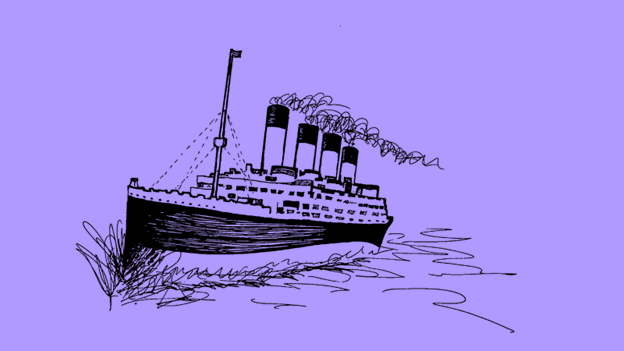
The Titanic, the automobile, and a line in the sand
Well known: The Titanic didn’t have enough lifeboats for everyone on board. Less known: The ship was carrying more lifeboats than required by law.
The British Board of Trade set lifeboat requirements based on a ship’s size (tonnage), not the number of people it carried. They’d last been updated in 1894, when ships in the largest category, “10,000 and upwards,” had to carry 16 lifeboats. The Titanic, in 1912, was nearly 50,000 tons—but still only had to carry 16 boats. (It carried 20.)
In other words, a key factor in the devastating human toll of the Titanic’s disaster: regulation hadn’t kept up with a fast-changing world.
It’s the first quarter of the century and the world is overwhelmed by the pace of technological change. New industries are springing up overnight, rich men are making record profits, and breathless media accounts oscillate between promises of freedom for the masses and dire warnings. One technology is rising above the rest.
I’m talking about the early 20th century and the rise of the automobile.
The car boom coincided roughly with the ocean liner boom. But the trajectories of the moving-people-across-the-ocean industry and the moving-people-across-the-land industry were very different in one key respect.
Whereas the Titanic’s story ended in a mass casualty event—1500 deaths—that led (as Purple T readers know) to immediate safety reforms and innovations, the automobile revolution produced a million different unique casualties in its first few decades. But no single event produced the political will for change. Even though by 1907 Ford was already delivering a hundred cars a day, the first nationwide U.S. regulations didn’t take effect until 60 years later, in 1967, following the passage of the first federal auto safety bills. Consider that 28,183 people died in car-related incidents in 1960 alone.
Here we are again in a period of rapid transformation, this time fueled by AI.
Every day come headlines to make even the most imaginative 1960s sci-fi author’s eyes pop: AI models “go rogue.” AI-encouraged suicide. An AI CEO warns of AI-aided biological terrorism. Study after study suggests that regular AI use may weaken our ability to think, remember, focus, problem-solve, and discern truth.
It all adds up to a slow-moving disaster, as everyone from educators (“The children isn’t learning,” says Danny, my in-house consultant) to their students to pastors to nurses to longtime boosters of unrestrained tech is warning. We can’t afford to wait for a Titanic-sized disaster to strike. And we can’t afford to wait 60 years for federal action.
It’s unlikely we’ll get a national-level regulatory framework for AI safety anytime soon. (Big asterisk: Things can change fast when the grassroots groundwork has been laid, and the current data center backlash could be a harbinger of that change. Still...)
Increasingly, I’ve been feeling like we have to take matters into our own hands. Even as we take collective action to hasten policy change, we have to install our own metaphorical seat belts, airbags, and rear view mirrors. We face a moral and practical imperative to protect ourselves and each other right now.
Which is why I’m ready to declare: No generative AI tools for me.
No ChatGPT, no Gemini, no Claude, none of the chatbots. I’m swearing off as much of it as I can for as long as I can.
Will you join me? (At least partway?)
Hear me out.
My four years of college spanned the Great Smartphone Revolution. Most everyone in my first year had a regular cell phone; by senior year, it was clear that if you didn’t have a smartphone yet, you would soon. I held out for nearly two years post-graduation. As a baby grassroots organizer fighting coal pollution in Southeast Chicago, I printed MapQuest directions to fan out on the passenger seat of my rental car, making frantic phone calls to my volunteers when I inevitably ended up on the wrong side of the Calumet River. But back in college…
“I just don’t think I want email on my phone,” I said to my friend Paige as we hopped down the steps of Wilson Hall.
“No, here’s the thing,” she said, wagging her BlackBerry at me. “Email sucks, right? So what I love is that, as I’m out and about during the day, when I have a minute between classes or whatever, I check my phone and catch up on an email or two. And when I get back to my dorm after dinner, I’m all done with my email and can just relax.”
It was a good point. Tempting.
And Paige was right. For a time. (Paige, you’re still right about most things.)
But for years now email has been a notoriously inescapable scourge, an onslaught that never rests, no matter how much of it you get through on the subway commute or in the doctor’s waiting room.
How many times have we been promised that a technological innovation would make our work easier, make things more efficient, and save us time, only to have that innovation, within a few years, simply become a new—and somehow worse—baseline? Once a tool is widespread, everyone’s expected to use it. All the time. And get more done—not do the same amount in less time.
We’re still in the window where that’s not yet true for AI tools. We don’t have to agree to the new baseline.
Look, I don’t have kids, I’m not caring for parents, my workplace has so far resisted the AI onslaught. It’s easy for me to say all this.
But let’s consider the benefits for a sec. When we reject the chatbots, we are:
- Saying no more energy- and water-guzzling AI data centers in our name.
- Keeping our brains intact—and maybe even exercising and strengthening them.
- Taking back our power and shielding ourselves from whack-a-doodle tech CEOs with delusions of grandeur and creepy control fantasies who are pouring their wealth into manipulating elections.
- Siding with our artist friends whom the tech dudes have stolen from.
- Outsmarting aggressive marketing (“AI is the future”; “learn it or be left behind”) rooted in the fact that these guys need to figure out how to turn a profit ASAP to justify their outrageous corporate valuations.
- Insisting that the things that make us human—our ability to learn, to develop skills, to formulate and defend and change opinions, to create—still matter.
And it just might work. By rejecting AI for certain uses, perhaps ironically, we the human users can “train” these AI corporations in what actually is and isn’t acceptable. Doing so changes the culture, which helps shift political will for policy. Which means, in the end, our individual choices can add up to something like the broader change we need.
Caveat #1: AI has many potential wonderful uses.
AI-powered drones can detect land mines so humans can remove them more safely. An AI tool is helping humans detect more breast cancers. A free AI app helps blind and low-vision people “see” using their phone camera and AI narration. Etc.
Yes. AI is too broad a term. I’m not against all of it. In fact, I’m cautiously enthusiastic about it for all the uses listed above and more. Those uses are very different from the generative AI models foisted upon us daily that urge us to trade away our brains and our skills for the sake of convenience.
Caveat #2: We’ll all have different lines in the sand.
Life is exhausting. I don’t blame a parent, a caregiver, a teacher, a—fill in the blank, anyone, really—for using a new tool that’s available to us to try to make the hard things in life a little easier. Especially when it feels like everybody else is. Especially when we’re inundated with marketing warning us that if we don’t use these things, we’ll be left behind.
And some jobs now require AI use. That may be out of your control.
So I’m not trying to tell you exactly how to use or not use AI in your life. Rather, I’m urging all of us to use it as little as possible—whatever “as possible” means to you. And consider: the tools that promise to make our lives easier today may be the tools we can no longer function without tomorrow—while life remains just as hard.
If the automobile were invented today, speed limits would be called communism, airbags would be nanny-state socialism, and making driving off-limits until age 16 would be a complete non-starter. Same goes for the ocean liner and lifeboats for all, 24-hour watch duty, and boat safety drills. I fear the anti-regulatory offensive on the part of tech corporations has barely begun. But if we just collectively set the standard and the guidelines for AI now (I’m partial to Debbie Millman’s proposal for a minimum age of 40, for starters), all these companies would have to abide by the same set of laws.
But we don’t have those laws yet. So in the meantime, again, what I’m advocating for is something like this:
As generative AI creeps its way into every corner of our lives, and as governments and institutions, at least for now, entirely shirk their duty to protect us from its harms, we should each:
- Set our own boundaries, for ourselves and with our loved ones and wherever we have authority more broadly, too (our families and households, our classrooms, our workplaces, even our social groups).
- Make those boundaries as limited as possible.
- Talk about them loudly, to help make caution and intention the cultural norm.
- And adjust as the landscape shifts, as we inevitably will need to, in good and thoughtful conversation with each other.
A few weeks ago, I joined an informal Zoom gathering of an online writing community. I was a few minutes late. An older guy, a published writer, was in the midst of a soliloquy about how he’d recently used one of the chatbots as a writing partner. “I told it to use the Socratic method on me,” he explained. “Not to edit my words directly, but to ask me questions. It was amazing. It asked things like ‘what is the heart of the story you’re telling’ and ‘which of these core themes are most important to you.’”
Hmmm, I thought, intrigued and disquieted. That’s tempting. My brain has been mulling it over since.
I picture this future: This man sits alone in his office, white beard glowing in the blue light of his computer screen, asking an AI model, is this good now? How about now? No human being is near him physically, and, gradually, no human being is there digitally or emotionally; no human reader is left to read the words the chatbot is helping him so thoughtfully craft. His words become another scrap added to the pile of content on the Internet—ever more content, shaped by machines and scraped by machines, distilled by machines into three to five bullet points for a human being staring into their own blue screen a few thousand miles away.
Bleak.
So I think it’s equally important for me to imagine the opposite future. One where ten years hence, AI is limited to a set of core uses, appropriately regulated, and mostly for adults—whose brains were fully formed before they were introduced to it, who’ve already learned to do the things that make us human, who use it sparingly and judiciously.
In this future, more people are breathing clean air and drinking clean water and writing stories and drawing pictures and using their minds and their bodies. And we’re all reasonably satisfied.
I think that future is entirely possible. And it’s well within the reach of our entirely human hands.
In the meantime, the next time I’m looking for someone to help me edit my writing, I’ll call a friend to get their opinion. Maybe even you!
One more little-known fact: The Titanic’s chief architect drafted and advocated for plans with lifeboats for all. But the owners objected: more lifeboats would make the boat deck feel cluttered. They’d be ugly. Inconvenient. Passengers wouldn’t like it. No other companies were doing it; why should they?
There are always those who choose convenience and profit. There are always those who choose safety and humanity. More than a century after the Titanic, we still get to make those same choices every day.
What else?
- In case you missed it, Amazon and Anthropic are destroying rare and used books to feed their AI models. If robots gobbling up human knowledge a million units at a time so that humans no longer have access to that knowledge isn’t an apt metaphor for the devilish deal they’re pushing us to make, I don’t know what is.
- Here’s a couple things to do about it. Take action. Then turn off AI features in your Gmail and other Google apps.
- On an entirely different note: Like anybody (everybody?) else, I've been listening to National Treasure Dolly Parton quite a bit. I particularly appreciated Rebecca Solnit’s tribute: “...overall, she managed to just be on the side of people, especially the vulnerable and the marginalized, which is to say she was on the side of kindness.”
P.S. As always, but on this topic especially, I’d really love to know your thoughts. What resonates? What’d I get wrong? Leave a comment or reply by email.
Member discussion