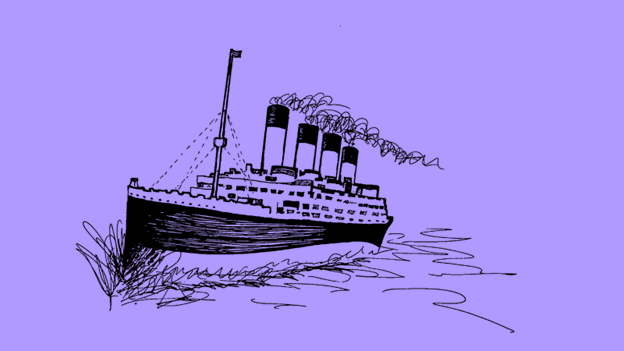
Meet Mallardine & Whimbrel O’Malley
I’m standing at the grocery store avocado bin, feeling for ripeness, when the woman at my elbow—about my age, in a big floral muumuu—offers me a broad smile: “Your lady is great!”
She has me confused with someone else, I think. She continues: “I told her I was tired and she offered me some of her coffee!”
Before I can reply, Shira, over by the tomatoes, chimes in: “Oh, that’s so funny. People keep thinking that! We’re not married. We’re twins!” (We’re not.)
It’s the first day of our brother–sister Alaska trip, and we’re shopping for lunch supplies and hiking snacks. The same thing had happened the night before. At the rental car center in Anchorage airport, where the gray sky shining through the glass façade seemed to contradict the clock hands approaching midnight on the wall above her, the attendant had asked Shira, “Do you wanna just use the same phone number as your husband?”
I guess it’s a little uncommon for two grown siblings to ditch their partners (and, in Shira’s case, kids and dogs) for a week to go on vacation together. But I guess we’re also a little uncommon.
I affirm Shira’s greatness to the friendly avocados-and-muumuu woman and we all laugh and part ways merrily. I wonder if this will keep happening.
On the drive back from the grocery store, it occurs to me that it’s reassuring to know that we could pass for a straight couple if we wanted or needed to, far from home in a foreign land. I don’t mention it to Shira.
In the kitchen of our rental, we make avocado-chickpea sandwiches, a variation on the avocado-chickpea crackers that were our standard meals on the family road trips of our childhood. Then it’s back out to hike Flattop Mountain. It’s a postcard-perfect hiking day, sunny but not too warm, and the luxury of the endless afternoon granted by the midnight sun stretches out before us. We climb through forest, field, and snow, stopping to take pictures in a grove of knotted and gnarled trees, where the sun filtering through the leaves reminds us of the fairy forests our seven-year-old niece inhabits in her imagination. We hoist ourselves up the final rock scramble, water bottles clanging against the stones. We reach the as-promised vast, flat peak and take in the snow-capped Chugach Mountains behind us and the city sprawled out before us. An American flag waves from a pole at one end of the plateau. Shira takes a picture of me touching my nose to the flagpole to send in the family group chat later: per our custom, a nose touch marks the turnaround point of any hike, and if you send a picture, everyone has to guess where you are.
On the drive back from Flattop Mountain, I notice a street sign. “Whimbrel Drive!” I faux-gasp. “How lyrical!”
“Whimbrel,” Shira repeats, her voice reverential. We both know what’s coming next. This is our long-running game, played mostly via text message: inventing characters with absurd names, names that sound real but aren’t. From time to time, I illustrate them and mail her the cartoons. She used to save them in a scrapbook. Then she and her boyfriend moved into a two-story apartment, and now they line the staircase in an ascending row like a set of family portraits.
“Mallardine!” she gasps, pointing at another street sign. “Whimbrel and Mallardine!”
“I think we’re on O’Malley Road,” I say. “‘Mallardine O’Malley’ has a nice ring to it, don’t you think?”
She does. “I saw another street sign back there that actually said ‘Nathaniel’ but I thought for a second it said ‘Northaniel.’”
“Brilliant,” I say. “Mallardine and Whimbrel’s sweet boy.”
It’s easy hanging with Shira—the only person in the world I’ve really known all her life. I was two and a half when she was born, and as the story goes, I was the first in the family to see her as a person, not just a baby. “My friend Shira,” I called her, and decided she was mine to watch out for. And that’s sort of how it’s been ever since.
We first started planning this trip more than seven years ago. But then travel was not a thing in May 2020. We postponed. We kept accumulating complications and delays. Now, I have more job responsibilities and a condo. She has two foster children, both under two years old. We each have a long-term partner. It took us until now to reschedule. We can still hardly believe we’re here.
Our week together plays out iced chai by iced coffee, avocado-chickpea sandwich by jam-and-cheese sandwich, mountain hike by glacier hike.
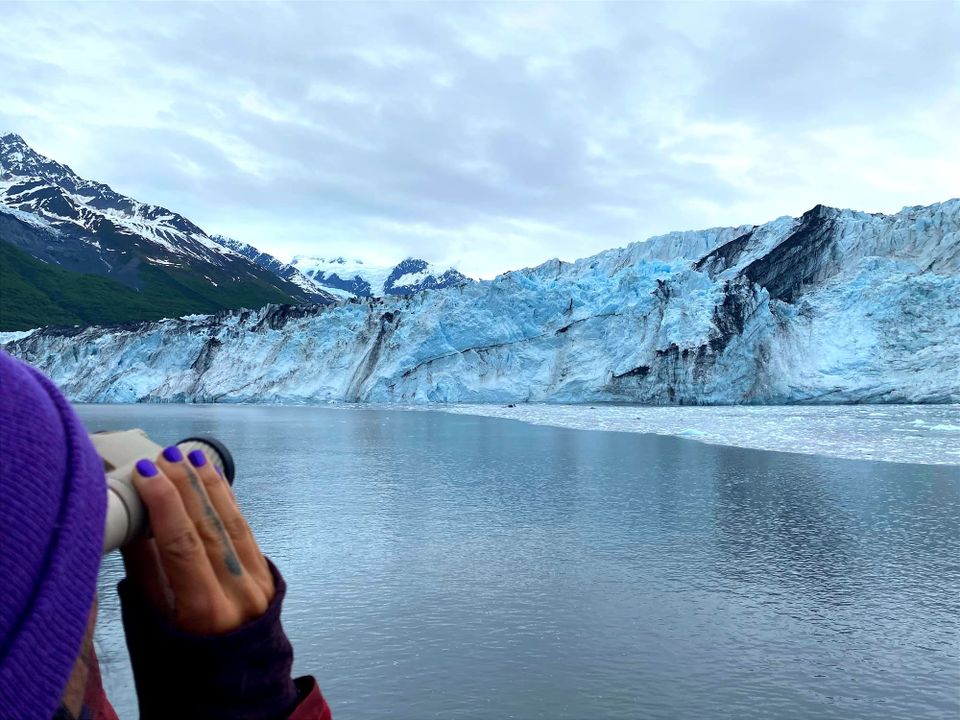
We book a five-hour “26 glacier cruise” on Prince William Sound. It’s boring, for a while. They keep us distracted from the tedium with bowls of surprisingly good chili and occasional whale sightings. I perk up as we approach Harvard Glacier, the biggest, at the far end of the fjord: There are bergy bits and growlers in the water and the ferry—not a small boat—is starting to zig and zag, dodging the biggest ice chunks… and it feels just a tiny bit like we’re on the Carpathia in the early hours of April 15, 1912, charging over the horizon to rescue Titanic survivors, dodging icebergs all the way.
We stop a third of a mile from the glacier. But it feels like we’re right next to the ice. The whole mass glows a muted but iridescent blue, interrupted by streaks of dirt and rocks. The only indication of our distance is the delay in sound—seeing a spray of what looks like pebbles fall from the side and plunk down, and then a couple seconds later hearing the cannon boom from across the water of what must in fact be ice boulders. The boat lingers: 15 minutes on the port side of the ship, a 180-degree turn, 15 minutes on the starboard side. The decks are lined with fellow tourists standing rapt and mostly silent, staring at the wall of ice before us, listening for the boom of calving bergs. It’s too big for the eye to really comprehend it. Eventually, I stop taking pictures and put my phone away and just lean my back against the railing, arms outstretched on either side, trying to take it all in, and failing, and then trying again.
Inside, on the long journey back through the sound, I sit with Shira pretending not to listen as one of our table mates says to the other, you know, I read somewhere that the last time the glaciers covered North America, the average surface temperatures were only four degrees Celsius colder than they are now, which really makes you think about climate change, doesn’t it? And I think to myself, yeah, it really does, doesn’t it, just as I notice, from a table over on the starboard side of the ship, a blonde family, all adults, laughing loudly, raising their souvenir cups of the ship’s proprietary Glacier Ice Margaritas, mugging for the camera, clearly not their first margs of the day, and clearly none of them thinking about climate change and melting glaciers, and I feel this icky pit in my stomach, that I’m here on this little boat, on the most frivolous of missions to visit these glaciers before they’re gone—just to gawk at them, not to do anything about the fact that we’re making them go. And I realize that the captain, for all his narration, hasn’t mentioned climate change once.
But maybe there’s a lighter side to it, too, I think. There’s something beautiful about this desire to see these things, to hold onto them, to be awed by nature and its power, and be reminded that we are all nature, too, in a time of accelerating alienation from the natural world. The boat was so quiet when everyone was standing there at the rail—taking their photos and videos, like any other tourists—but scanning, scanning, listening, listening, silent, for that only-in-nature sound of glaciers calving into the sea.
“This is the best thing,” Shira says, eyes and grin peering out at me sideways from underneath the hood of her rain jacket. It’s the next day, and we’re at the Alaska Wildlife Conservation Center.
“This wildlife center?” I ask.
“Yes,” she says. “And Alaska. This trip. Everything.”
We’re trudging in the rain along the gravel road from the bison enclosure back to the muskox enclosure. The bison had been grazing far from the fence, but one looked up, saw her, and with the air of “ah, my 2 pm meeting has arrived,” strolled straight toward her, then walked with her along the fence a ways, discussing private business.
The first thing we’d seen on arrival was a moose resting on the ground. She looked regal and unbothered, ignoring the gawking humans outside her enclosure. But then she staggered to her feet and squatted her hind legs to pee, and it was so familiar and human-like that that thought from yesterday’s glacier cruise sprang back into my head: We’re all just nature.
The thought follows me as we stroll the grounds. The big brown bear lumbers around her little hills, each hind leg arcing to the side before she plants it, toes pointed slightly out, almost bowlegged—exactly how a human in a just-a-touch-too-big bear costume would walk. And the muskoxen: They look world-weary and prehistoric, with their long beards and stubby horns and ratty molting coats, like they were there at Sinai to receive the Ten Commandments and have long since lost any remaining fucks. They munch their grass and look right through the human animals surrounding them with our cameras.
The week accelerates, as vacations do. We take another epic hike into snowy fields overlooking a sprawling glacier in Kenai Fjords National Park, with another nose touch at the end. We bike the coastal trail in Anchorage. We visit the Alaska Jewish Museum.
Before we know it, we’re on a plane heading south together. I spend three days in Oregon meeting Shira’s new foster kids, and then it’s already time for me to go home.
On the flight back to Boston, it dawns on me that no one after that first day assumed that we were a couple—at least, not that we knew of. And I realize, too, that I’ve been waiting for something, some theme of the trip to reveal itself as the deeper meaning of the whole thing. In those first two days, I thought that theme might be how easy it is to pass as straight, and how it feels safer to do so in a wild-feeling place like Alaska. Later, I thought it might be something about climate change, how the wildness of Alaska, the ever-present immersion in nature, makes stark the changes and losses of our precious planet.
And yes, it’s jarring that two siblings who look extremely alike can pass for a couple just because heterosexuality is the default. Climate change is a crisis, and glaciers are a potent reminder of it. And we’re all just nature, no matter how much we separate ourselves from it.
The real world has a way of seeping through the cracks of any vacation.
But the trip was more about the avocado-chickpea sandwiches, the hikes and nose touches, and Mallardine and Whimbrel and Northaniel. It was about the language, experiences, and weirdnesses you can only share with someone you’ve known for as long as you can remember. I don’t know when, if ever, we’ll get to do this again.
The woman at the grocery store was right: My sister is great. And in the end, the deep meaning of our week together was that we had a precious week together. And it was, indeed, the best thing.
What else?
- Proud partner alert: Danny’s latest translation is out, a genre-bending modern-meets-fantasy novel called Air, hailed as “glass-like and pristine” (The Wall Street Journal), “mesmerizing” (The Observer (UK)), and “eerily, unaccountably compelling” (The New York Times).
- Two of my funniest colleagues are writing on Substack! Check them out:
- Melissa is chronicling the pleasures and struggles of being 55, in perimenopause, and bursting with a creative energy that the Boston suburbs can’t contain.
- Anusheh is writing about deep, thought-provoking, political stuff (also cats, also pop culture) in the pithiest and most Gen Z way (compliment).
- This might be the AI-takedown folk anthem I didn’t know I needed.
Member discussion