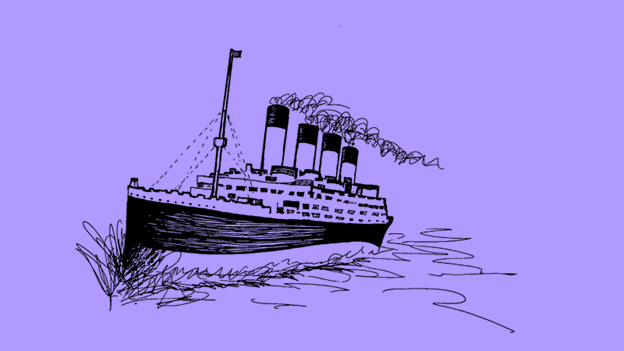
A zig-zag in the ship's wake

There’s a scene in the novel From Time to Time where a man and woman who’ve time-traveled back to the Titanic decide to change history. They visit the ship’s wheelhouse, and Helen starts to clown around and flirt with the man steering the ship. She holds her scarf in front of him, then lets go so the wind catches it and blows it into the helmsman’s face. For just a few seconds, he can’t see. He lifts his hands off the ship’s wheel, sputtering, to claw the scarf away. Afterward, Helen and her co-conspirator, Simon, race to the stern. They see a visible zig-zag in the ship’s wake, and they laugh with relief, certain their tweak to the ship’s course will be enough to avoid its collision with the iceberg.*
When does a little tweak matter?
Modern election season means the hot takes about voting fly fast online. They range from “Voting is worthless because…” (the system is rigged, my vote doesn’t matter, the choices are all bad, etc.) to “Voting is our last great hope because…” (it’s the only mechanism we have, our ancestors died for this right, it’s how we get leaders who will make the changes we need, etc.).
If you know me, you know that I reject defeatism—because that’s a recipe for, well, defeat—and that I reject the notion that voting is our only chance at change—because time and again, organized people power has shifted the course of history in big ways beyond elections.
But I also think the online commentators are right, all of them. Many things can be true at once. Here in Somerville, my member of Congress doesn’t even have a challenger—my vote literally doesn’t matter in that race. But we have a record-tying nine measures on our ballot today, related to voter registration, auditing our very untransparent legislature, restricting legal cannabis, undoing gun reforms, and more—measures that could reshape my state and even my neighborhood. Measures that are expected to be quite close. Measures for which my vote could really matter.
In 2017, a race in the Virginia House of Delegates, with more than 23,000 ballots cast, ended in a tie—and the winner was ultimately chosen by drawing lots, which led to a 51-49 Republican majority. In 2020, Rep. Marionette Miller-Meeks of Iowa won her House seat by just 6 votes out of nearly 400,000 cast. There’s lots more where that came from, in every state in the union and beyond: If you’d like to follow me down the rabbit hole, this Wikipedia page is a fascinating starting point.
We just can’t know when our vote might make the difference—when the choice between getting out there or staying home, or dragging our partner or housemate with us, might break the tie. So we might as well vote as if each of our ballots will change the course of history.
Spoiler alert: As you might have guessed, in From Time to Time, Helen and Simon’s gambit has the opposite of its intended effect: They’ve steered the ship into the iceberg. It’s not the outcome they wanted, but their tiny action has major consequences.
The good news is that if you cast your ballot in favor of a candidate or measure that you support, there’s really only one direction it can influence the outcome. Unless you mark your ballot incorrectly, you won’t accidentally steer the ship into the iceberg. But just like Helen and Simon, we can’t know the magnitude of our action until it’s done.
So go vote. Vote as if your ballot might change the course of history—or guide us past the icebergs we face.
Love,
Ari
*It’s been a long time since I read the (highly recommendable!) book. Ruhi or someone, feel free to fact check the plot details in the comments.
Member discussion